Sunday, 6 October 2013

Review 7: Pandemic


This is the first co-operative game review that I have completed and in truth I couldn’t wait to complete it.  This game is brilliant to put it bluntly.  Any game that you can play as a team against the game itself, where you are all the winner or the looser gets a big thumbs up from me:
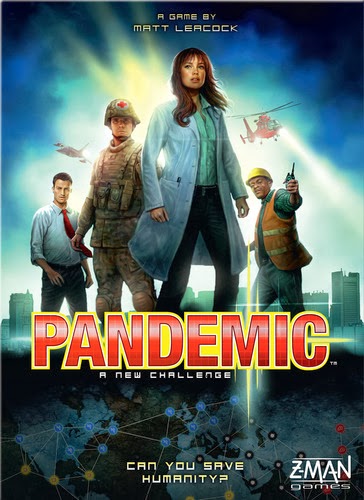

Name: Pandemic

Players: 2-4

Playing Time: 60 minutes

Suggested Ages: 13 and up

Awards: Numerous – most notably 2009 Spiel des Jahres Nominee & 2010 Australian Games Association Game of the Year

Game Setting:

Each player takes on the role a specialist who is trying to save the people of the world from four deadly viruses that are spreading through the major cities of the world.  Working together as a team the players must use their abilities to treat the viruses, share knowledge on how to find the cure and finally discover the four cures and save humanity.

 After the players have chosen their character cards are used to place cubes to represent the level of infection in certain cities around the world. 

The players are then dealt a hand of cards that form the starting point for finding the cures. 

Game Play:

On a players turn the first thing they do is take up to four actions.  These include moving around the board, either by moving directly between adjoining cities, taking a flight to a city from a card they hold in their hand, taking a flight to any city in the world from the city that they are at and matches a card in their hand or by travelling between research stations.  Each one of these costs an action.  As well as moving, players can carry out a number of other tasks for one action.  They can build research centres; find the cure for a virus by handing in 5 cards of the same colour, share knowledge but giving or taking a card from a player in the same city as them or treating the virus and removing a cube of the virus from the city that they are in.

Once the player has completed their four actions they then collect two cards and add it to their hand.

Finally the player completed the infection phase by seeing which cities are going to continue to be infected by their virus.

The players win Pandemic in only one way, they discover all four cures.  The players lose Pandemic in three ways!  The first is that there are no more cubes of a certain virus left when they need to be added to the board following the infection phase.   The second is if they have no more cards to draw from the supply deck to add to their hands.  The third is when there have been eight outbreaks of the viruses on the board.

During the part of a player’s turn when they are drawing cards to place in their hands, there are occasions when an ‘Epidemic Card’ is drawn.  This is what makes the game more challenging.  When this even occurs the player reviews a new city that is going to have three cubes placed on it.  Also the deck of cards that have been growing during the infections phase are then shuffled and placed back on top of the pile of infections cards.  The last step is to increase the infection rate.  The infection rate indicates how many cards are drawn from the infection deck when adding a cube to the board during the infection phase.

When a city has three cubes on it and a fourth is required to be added, an outbreak of that virus occurs.  All adjoining cities that received one cube of the virus and the outbreak marker is moved down one space.

To counter balance the difficulty of the virus each player’s character has a unique ability.  For example the Medic can remove all the cubes of one virus type in a city for one action rather than one action for each cube.  The Scientist by comparison is only required to hand in four cards at a research stations rather than five to discover a cure.  The Operations Expert can build research stations for free and Dispatcher can move other players as if they were their own.   Using these abilities effectively can make the difference between failure and success.  


My Score:

Game Play:  4/4
Components: 2/2
Replayability: 2/2
Theme: 2/2

Total: 10/10
 
My Comments:

This is firmly one of my favourite games.  Now that the artwork has been updated in a reprint this year the game, my opinion, now looks as good as it plays.  The reprint also comes with more characters given even more variants to the teams that can be set up.

What makes this game so good?  A host of reasons really.   The game is played as a team and so there is no feeling of any one person knowing that they are always going to lose.  The games is modern, it’s not set in the past, it doesn’t involve dragons or elves, castles or trains and so it has a setting  that most people can relate to.  The game has a great theme; who wouldn’t want to be part of the elite team that saves everyone from four deadly viruses spreading across the world? 

It’s a completely balanced game.  Even on the ‘introductory’ level where only four ‘epidemic’ cards are dealt into the player deck you’re not guaranteed to win.  I’ve found it’s still about a 50/50 chance of success just at this level.  The real brilliance comes when you’re sitting confidently in control of all of the viruses and then suddenly two cities outbreak and you find that while you’ve been busy in China and Japan you’ve turned your back on Washington, London and Essen where there is an explosion of the blue virus and no-one there to treat the disease.

There are three different levels of play with heroic at the top end where six ‘epidemic’ cards are dealt into the player deck.  I’ve yet to win a game at this level it’s that hard!

Inevitably you’ll get one or two people in the team who end up telling all the other players what they think needs to happen next and I’m trying to hold back from being that person (it has been known) and let the other players make the decision (even when I know it spells doom for mankind).

This is most definitely one for your Christmas list and I’m please to say that with the reprint it’s made its way into mainstream shops including Waterstones and Toys R Us.  This exposure should put it squarely into the hands of more families.  Just imagine the joy of Christmas afternoon when everyone is happy after the joys of the morning and then as a family you work together to save the world! Afterwards everyone then celebrates with mince pies and mulled wine!

If there are no other games from my reviews that you give a go, try this one.   It’s now an iOS app so you can give a try before even buying the board game (still buy the board game though – it’s far better than just looking at a screen).  Borrow a copy of the game if needs be and try it that way if you don’t want to commit, or even better, find one of us secret lot of gamers and ask us to let you give it a go with us!

Enjoy Pandemic and let me know what your thoughts are.

Review 6: Kingdom Builder


Kingdom Builder won Game of the Year (Spiel des Jahre) in 2012 and in my opinion deserved to do so.  It is one of the simplest games to play and teach but has high level of replayability due to its unique set up and points scoring system:


Name: Kingdom Builder

Players: 2-4

Playing Time: 45 minutes

Suggested Ages: 8 and up

Awards: Numerous – most notably 2012 Spiel des Jahres Winner

Game Setting:

Each player is trying to create a kingdom made up of growing settlements.  The aim of the game is to play settlements in the best position to score the maximum amount of points.    The board is made up of four segments which are placed as a rectangle but can be placed in any order and in any orientation.  On each board segment there is a special building that will grant players who build adjacent to it an additional ability on their turn.  Each board segment also contains a city which when players build adjacent to it score an addition 3 points at the end of the game.  Three points scoring are picked at random from a supply of different scoring criteria and are revealed to all of the players.   Each player is then given a card from the terrain supply ready to use on their turn.

Game Play:

Each player takes a supply of coloured wooden houses.  On their turn a player places three of their wooden houses on the board.

The placement of the house must be on the same terrain type as the card that they have in their hand.  Each house that is played must also be placed adjacent to an existing house on board.  The existing house does not have to be on the same terrain type as the card that is being used, however the house that is being played must still be placed on the terrain of the card.

When placing the buildings the player considers the three scoring cards that are on show to pick the best place to score.  For example if the ‘Miners’ scoring card has been chosen from the game the player will be looking to build as many houses as possible next to the mountain terrain type. 

Once the player has placed three houses the player then draws a new terrain card and play passes to the left. 

The special buildings on the board grant the players extra abilities, for example, the tower allows the player to build an extra house on the edge of the board, the harbour allows the player to move one of their existing houses to a water terrain space and the Oasis allows a player to place an extra house on a desert terrain space.

The game ends when the first player has placed all of their houses.

My Score:

Game Play:  3/4
Components: 2/2
Replayability: 2/2
Theme: 2/2

Total: 9/10

My Comments:

I’ve only recently dropped the score for this game down from 10/10 to 9/10.  It is a great game and I think a strong contender for first time players.  It is a really simple game to play.  Each turn you only have two actions, place the housed and then pick a new card.  The genius aspect to the game is the amount of variation.  There are 8 different board segments to choose from and they can be placed in a multitude of different combinations.  As each board segment has a different special building, the bonus actions change each game also.   Finally, with 10 different score cards and only three being selected each game, the strategy that is used to maximise the score changes. 

For me it’s this diversity to the game that makes it a solid game.  I think it’s better with more players because the terrain spaces on the board get filled up quicker which makes the scoring more challenging.

I’ve taken the game down a point from the maximum score and that’s due to the level of complexity.  For those people who are looking for a real challenge, this game is slightly limited.  The card you draw for the terrain type will tell you where to place your houses and this means your decision is limited.  For experienced gamers I see Kingdom Builder as being a filler game as I’ve not played it where it’s taken 45 minutes.  As long as the other players are planning their turn whilst they are waiting then the game is quite quick. 

The artwork is great and I love the fact that the terrain types do not conform to the normal;  Desert, Forest, Grassland, Canyon and randomly Flower Field!  It has a great feel and a depending on the scoring criteria, even the look of the kingdoms that the players create look different.  One game will have long sprawling settlements other will have one really large settlement and another will have lots of tiny settlements all over the board.

In my opinion it’s a game that people will go back to time and again and is relatively easy going of an evening.

Sunday, 22 September 2013

Review 5: Dixit


This is the first card game that I have reviewed and it is amazing! I watched it being played by Will Wheaton on his board game review web program TableTop on the Geek and Sundry Channel (have a look but be mindful that the language can be a little colourful at times).  I got a copy and then played it with friends.  Since then at least 2 of people I’ve introduced the game to now have a copy…..both with expansions (that I enviously don’t have).   This game well deserves its award for 2010 for Game of the Year in my opinion:

Name: Dixit

Players: 3-5

Playing Time: 30 minutes

Suggested Ages: 8 and up

Awards: Numerous – most notably 2010 Spiel des Jahres Winner

Game Setting:

Each player is entering into a game of second guessing and careful consideration.  The key is trying to think with the same mind as the other player, but not wanting to be thinking the same as all of them.   Every card is unique and the players move rabbit shaped playing pieces around the scoring track set in the inside of the game box.  

Game Play:

Each player takes a coloured rabbit and places it on the score track and then takes the corresponding coloured numbers depending on the number of players in the game.

Each player is then dealt a hand of cards.  Each card has a different and very bizarre picture on it.  When I say bizarre I refer to a blazing heart in a bell jar or a man on a ladder chiselling clouds.   More examples include two ants sword fighting on top of a stack of coins or an elderly man made of autumn leaves walking towards distant hills.

Each turn the players whose turn it is selects a card from their hand, plays it face down and then uses a ‘sound’, ‘word’ or ‘sentence’ about their card.  The player can say whatever they like about their card.  However depending on what is said will impact on the scoring.  All the other players then choose a card from their hand which they think could be interpreted as the start player’s card and lay it face down also.

Once all the cards have been laid face down, they are then shuffled and turned face up.  Each player (expect the players whose turn it is) then attempts to try to work out which card is the start players card.  Once all the votes have been cast using the coloured numbers the start player reveals which was their card.

The scoring then takes place.  If all the players have guessed the start players card, they all score 2 points and the start player scores nothing, in this example the start player has made their ‘sound’, ‘word’ or ‘sentence’ too obvious.  Similarly if none of the players pick the start player’s card they all score 2 points and the start player scores nothing and in this example the start player has made his card too difficult to work out.  For the start player to score, at least one of the other players needs to pick their card (but not all of them, as outlined above).  When this happens the start player scores 3 points and any of the players that guessed the card also score 3 points.  For anyone who did not pick the start players card, they give a bonus 1 point to the person who laid the card that they thought was the start players card.


After the scoring each player takes a new card and play passes to the left. The game then simply continues from there until either there are no more cards to be drawn or until a player scores 30 points.

It’s as simple as that. 

My Score:
Game Play:  4/4
Components: 2/2
Replayability: 2/2
Theme: 2/2

Total: 10/10
My Comments:

This game is one of my very favourites.  It is brilliant and so unlike anything else that I’ve played.  It’s easy to teach, easy to play and open to anyone.

The key to Dixit is that no single player is left feeling that they are at a disadvantage because of one key factor, each card can and is interpreted in any way that the player wants it to be.  One player will see a card and think of a film quote, another player might see the same card and think of a book reference.  A child may look at the same card and simply say “this card scares me” and another player might look at one some detail in the picture and take something from it.

I’ve played this with lots of different people and even the more reluctant people have enjoyed it, so much so that I’ve found that one game is often not enough and it’s usually played two or three times in a row. 

Different people bring different feels to the game as well, which is a feature of the game I like.  I’ve played one game where almost all the cards were film references and have played another game where the cards were referred to as experiences from our uni past.

The art work feels non-threatening and the fact that the score track is part of the box itself just adds to the planning that has gone into the game.

Why Rabbits, no idea!  Does it make a difference, no.  Is it random like the cards, yes.  That’s why I love this game.  Why is it called Dixit, well that I can answer, Dixit is the French word for ‘he said’ and as it’s a French designed game it all fits.

To give a balanced view however there is a couple of draw backs.  The first is that the more times that the game is played with the same people the more the cards become increasingly difficult to think of new ways of interpreting the cards.  Secondly if you play with groups of people who have played before there are instances where players uses the cards in ways that some have heard before but not the others, therefore creating easier scoring rounds.

The last feature, which I have found, is that the after a while you get to know the cards and therefore you start second guessing what card has been played before you even see it.  The expansions allow for more variation and I think that there is a lot of mileage in this.  

In my view these are only minor issues and only come after playing the games many times.

Overall a score of 10/10 is well deserved and Dixit is a firm favourite by the majority of those who give it a try.

I would absolutely recommend people to pick it up and have a go, in fact I would say this over all the over games that I have reviewed so far.  Christmas is coming and for anyone who wants a great new game to play after the dinner is done, this will go down a treat.  If you’re not celebrating Christmas then you can pick up and play dixit even sooner!

Review 4: Stone Age


This game is the first worker placement review that I have done.  Admittedly there are better worker placement games out there but Stone Age is a less well known game of this type compared to some of the others.    Worker placement, for those who have not come across this term before, is where players are placing their playing pieces on the board in order to choose an action that will aid them in the game.  I like worker placement games but they’re not for everyone:

Name: Stone Age

Players: 2-4

Playing Time: 60 minutes

Suggested Ages: 10 and up

Awards: Numerous – most notably 2008 Spiel des Jahres Nominee

Game Setting:

The game is set (not unsurprisingly) in the Stone Age.  Each player takes a player board and places it in front of them.  The player board shows the player’s Stone Age village.  In the centre of the table is the games main board which shows all of the actions that the players Stone Age villagers (workers) can take.  The Play takes a number of Stone Age Meeples (pieces) and puts them in their village ready for sending out to carry out tasks.

Game Play:

Each player chooses a colour and takes the ‘meeples’ that match that colour.   On their turn the player players take it in turns to place of their meeples on one of a multitude of different actives.  For example a player can choose to collect wood, collect clay, collect stone or collect gold.  Alternative a player could gather food or do some early farming.  However they could choose to have a child or make tools.  If it’s extra points they want a player could choose to trade at the river or build more huts for their village. 
 

The winner of the game is the person who scores the most amount of points and this is achieved in a number of different ways based on the decisions that are made above. So a player could score 14 points by building a hut, but to build that hut he would need to pay 1 clay and 2 stone that the player would have collected from previous turns.

A player has to decide how many of their Stone Age Meeples they commit to the activities of collecting resources as this impacts on how much they can collect.  1 meeple collecting wood, would roll one dice and divided the result by three.  2 meeples would allow 2 dice to be rolled and the result of the roll is then added together and then the total is divided by three, thus increasing the amount of wood that could be collected.  By comparison collecting gold requires the dice roll result to be divided by six. 

Certain choices on the board are only available to a limited number of meeples and so on some turns players will not be able to choose the action that they really want and will have to wait for a later turn.
 

At the end of the game turn each player must feed the members of their village using the food that they had gathered. 

The game ends when one of the hut stacks is reduced to zero or the last trading card from the river is taken and can’t be replaced by another.  The scores are then worked out by looking at the current position on the score track of the player and then working out any bonus scores from the trading that has been done at the river. 

My Score:
Game Play:  3/4
Components: 2/2
Replayability: 2/2
Theme:  1/2

Total: 8/10
My Comments:

Stone Age is a really fun game for all the family to enjoy.  For me the artwork is amazing and reminds me of a game a played when I was younger (Forbidden Forrest) where the boards have some many details depicting Stone Age life.  I like this in a game, especially when it is other players turn; it gives you something to look at while you’re waiting for them to decide what they want to do for the turn. 

My favourite type of game is worker placement however I am very aware that for a number of people this style of game can be really frustrating.  For some people who set out a plan of exactly what they are going to do for a turn and then find they can’t do it because of players have chosen the actions that they wanted to do, it can become really challenging to rethink a plan.

In truth the scoring is hard to follow at times, there are a multitude of different was to make scores and it can sometimes become confusing on what is the best course of action to maximise your score. 

I gave it 8/10 as I think this game is really good and I enjoy it when I play it.  Is it the first game I go to if I’m going to play this type of game? No.  In my opinion there are better games (which I’ll review later).  The drop in two points comes from two main sticking points.  The first is the setting.  The Stone Age puts a lot of players off even though the artwork is really great.  The second is probably for me the biggest snag to the game.  The collection of resources requires a player to divide the totals on the dice that are rolled between 2,3,4,5 and 6.  If like me division is not a strong point it can become a sticking point to the game while you try and work it out.  I think it’s a shame because there are other ways that resource acquisition can be managed to make it fair for the players.   On the flip side, the more you play the better you’d get at dividing so maybe this should be an incentive to improve yourself.

Dice rolling in a game like this will be a big turn off for other players. In a bad rolling game, no matter how good the strategy or plan, you are unlikely to be able to make the progress that you’d like.

Overall I’d say if it’s your first delve into worker placement, I’d suggest you try other games like Agricola, the Village or Lords of Waterdeep that don’t rely on dice rolling.  However if you’re looking for something a bit different then this might be the game for you.  Actually, in a dice rolling game, if you’re playing someone who always wins because they can see a plan far better than you can, the added complication of luck, may still give you the edge over them.

This game has depth and replayability and can be played with older children as comfortably as adults.  It can be a little bit long to play but not unenjoyably.

Have fun!

Saturday, 14 September 2013

Review 3: Hotel


I wanted to give you a game review this week that didn’t score a full 10/10 but still held its own against the well-known.  In truth, this was the game that really hooked me in when I was younger.  It was the game that the adults got to play and the children didn’t.  It looked great as the game progressed and was easily played over a course of an evening:

Name: Hotel

Players: 2-4

Playing Time: 60 minutes

Suggested Ages: 8 and up

Awards: None

Game Setting:

The game is set around the world and players taken on the role of hotel owners, buying them, building them up and then enjoy those occasions when other players come and stay at them.  However at the same time as other players are staying at your hotels, you are staying at theirs.   

Game Play:

Each player chooses a colour and takes a car that matches that colour.   On their turn players roll the die and move the number of spaces.  Depending on the space that they land on the player will mostly be able to either buy the land on either side of the road or building sections to a hotel they already own.

 
When a player wants to build they roll the permission die to see if they roll a ‘green’ for being able to build at normal price, ‘red’ for not being able to build, ‘H’ for a free section to the hotel of ‘X2’ to pay twice the amount.

Other spaces include gaining free parts to the hotels and free entrances to the hotels. 

When the players make it past the town hall they are able to buy entrances to their hotels.  These entrances are then placed on the board adjacent to the hotels that the player owns.  As soon as other players then land on the on the spaces with entrances, before taking the action from the space, they must stay at the hotel.

 
To stay at a hotel the visiting player rolls a die to see how many nights they stay.  Once they know how many of the 1 to 6 nights they’re staying the hotel owner then checks the number of nights against the number of sections to the hotel they have managed to build so far.  The visiting player then pays the owner the required amount.

Failure to pay means that hotels are put up for sale.  As soon as a player has no more money they are out of the game.

 
The winner is the person who is left in the game, holding all of the money and all of the hotels.

My Score:

Game Play:  3/4
Components: 1/2
Replayability: 2/2
Theme: 2/2

Total: 8/10
My Comments:

For those of you who love Monopoly, this one is going to really put your love for the game to the test.  In just the same way as Monopoly, some of the hotels cost more to build but cost more to stay at.  Players move round the board in the same way as in Monopoly and will get money from the bank each time they pass it. 

For me, where this game edges it past Monopoly is due to how fantastic the board and the hotels look.  3D, large hotels build up throughout the game and then once the hotel is finished the owning player can add facilities to increase the amount that can be charged to other players. 

The fact that you may or may not be able to build or the build is going to cost you twice as much creates a sense of risk.  The chance of rolling a free hotel drives you to sometime build when you shouldn’t.   Knowing that you just need to build one more section of the hotel and have someone stay just a few nights gives the feeling of hope which is sometimes lost in Monopoly when you know there’s three sides of the board for the other players to get round before they get to your single house.

The great thing in this game is the person who buys the most expensive hotel is not guaranteed to win and neither is this true of the person who owns the most hotels.   In Hotel the game moves on at a quick place and layers don’t left feeling as though they’re doomed to lose from their second trip round the board.

The version that I have and is pictures above, you can’t buy anymore but there is a newer release which I have to say looks great….maybe one for the Christmas list.  It appears to use planes rather than cars for the playing pieces, which makes sense as the hotels that the players are buying are all over the world.  The hotels look even better than they did before including one that looks like a tree house hotel.  It looks like a fresh remake that still works well as a game.

I didn’t give Hotels 10/10 for two reasons (hence the loss of 2 points).  The first is because the game is limited in depth.  I sometimes find that roll of the dice games means that there is often one player who feels that they are never going to win.  Games that have less randomness give players the chance to plan and offer the chance to create a way out of the position.  In Hotel, rolling the dice also means that there are a limited number of decisions that you can make on your turn.  The choices are more about “do I spend the money now and hope I don’t land on someone else’s hotel” or “play safe and save the money while other people build their hotels around me”.

The second drop in point is due to the design.  Don’t get me wrong the game looks far better than almost any Monopoly board and there is a huge feeling of satisfaction when you see the towers of the President hotel rising high above the board, shining in their reflective surfaces making you lots of money.  However one slight knock of the board and a large number of the hotels can come crashing down, scattering entrances across the table and displacing the players playing pieces.   You’d think it doesn’t happen very often, but a careless loose sleeve whilst moving your car or a fumbled pass of a fiddly entrance is enough to tempt fate.

Overall I’d say to anyone give this game a try (the new versions still seems to have all the look and feel of my version).   It’s a less stressful version of Monopoly and is certainly quicker to play.   IT LOOKS GREAT.  There are very few games that are not young children’s games that looks as good as this one.  Forget little red hotels and green houses, have towering buildings with swimming pools, tennis courts, beaches and parasol covered tables.   An 8/10 is still a good score.

Anyone who has played the latest version out this year ‘Hotel Deluxe’ let me know how it plays!


Friday, 6 September 2013

Review 2: Carcassonne


Review 2: Carcassonne

Time for a second review and this time I decided to go for a really popular game.  Many of my friends who have played it now own copies themselves and as there are a number of expansions available the game had lots of scope for growth and change in game play:

Name: Carcassonne

Players: 2-5

Playing Time: 30 - 90 minutes

Suggested Ages: 8 and up

Awards: Numerous – most notably 2001 Spiel des Jahres Winner

Game Setting:

The game is based on the French medieval town, Carcassonne.  The game is played on an ever growing landscape created by laying tiles.  Each player is using their ‘meeples’ (playing pieces) to take on a different role to score points throughout the game.

Game Play:

Each player chooses a colour and takes the ‘meeples’ that match that colour.   On their turn the player selects a tile from the pile and choose where best to place it adjacent to the existing tiles.  Each tile depicts a feature that will provide scoring opportunities.   The player then chooses whether to place a meeple on the tile that they have just laid.

There are four ways to score.  The first is placing a Meeple on a road (acting as a thief on the road).  Once the road has been completed at both ends the player immediately scores 1 point for each tile that the road goes through.  Once scored, the Meeple returns to the player’s available stock.

The second is placing a Meeple on a castle segment (acting as a knight in the castle).  Once the castle is completed the player immediately scores 2 points for each tile the castle goes through and a bonus two points for each pennant the castle has.  Once scored, the Meeple returns to the player’s available stock.

The third is placing a Meeple on a Cloister (acting as a monk).  Once there are 8 tiles surrounding the Cloister the player immediately scores 9 points.  Once scored, the Meeple returns to the player’s available stock.

The final way of scoring is laying a meeple down on the green space on the tile (acting as a farmer).  These Meeple never return to the player’s available stock. At the end of the game the player scores 3 points for each completed castle that the farmer green space touches.

There are a couple of other scoring criteria and points are scored a little differently at the end of the game but the scoring is easy to pick up.


My Score:

Game Play:  4/4
Components: 2/2
Replayability: 2/2
Theme: 2/2
Total: 10/10
My Comments:

Carcassonne is an easy game to play and a great game to introduce people to different games to the ones that we all know and love.  The scoring is easy to understand albeit that the farmers always pose the greatest challenge for first time players. 

The art work looks great and supports the feel of the game.  The ‘Meeples’ are fantastic being wooden, and keep with the quality of the tiles. 

As the players gain a better understanding of the game play the game itself gets better as players start to use tactics to ensure they score the most amount of points possible.   For me this is when the game is at its best. 

It works wells as a two player game as well as a five player game but the number of players does change the type of choices that a player makes when they are deciding whether or not to place one of their meeples.

I would say that this is a challenging game to play on a small table, but works well most dinner tables, or even on the floor.

The expansions make a great game even better and I would recommend you to have a look at what’s available after you’ve given the base game a try.  I’ll do reviews on the expansions in later weeks.   

Enjoy and let me know if you give it a go!